Monday, 2 February 2015

Pitching my film, "Fixated".


We were asked to create a presentation to pitch the concept of my movie, "Fixated". Below is the first draft of my pitch:


This is the presentation from the first draft:


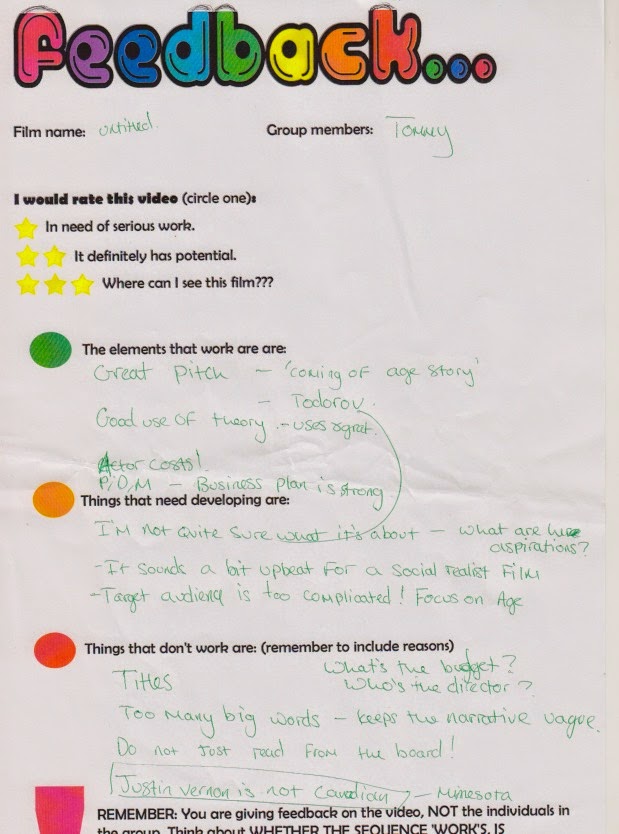
List of feedback sheets for the first draft:


From examining the feedback I received, I went off and edited my pitch. These are the things I changed, based on feedback: 

  • I settled with "Fixated" as my title, due to asking my classmates they all agreed on "Fixated" because it seems more intriguing and hooking. 
  • I focused on adding less of a bulk of writing, as it's a pitch I don't want to be force-feeding too much information into the person's mouth, although a lot of information proves thorough planning but it's a lot to take in; therefore, I condensed information into bullet points where possible, and even went a step forward by highlighting key points in red.
  • Also to make information more outstanding, I incorporated more photos to instantly convey my ideas. Such as photos of actors, directors and also my production/distribution company.
  • As well as focusing more on my target audience as they will be the ones who will be watching this movie. I got told my target audience was "too broad" therefore, I narrowed it down and also added an age certificate as I forgot last time. Furthermore, on my first draft I had a slide dedicated to many types of target audiences from aspires to resigned, I got told to focus on one/two of these groups.
  • My budget was apparently, "too high", I figured this out due to wanting Bon Iver's frontman, Justin Vernon, to create the soundtrack, as well as the actor and director costs, locations and mise-en-scene features the budget did seem a bit too low. Consequently, I increased the budget to £2.5 Million, I chose a British songwriter, Chris Martin, and also changed my actors to less-known actors but kept the director. 
  • My narrative wasn't clear and concise, therefore I altered the slide to include a clearer run through of Ruby's dream and what she wants to achieve. 


Sunday, 1 February 2015

Title change: Fixated

After the feedback from my peers, I gathered that the title, "livingstone" wasn't very memorable; also slightly cheesy. Alternatively, I had a backup title for my title sequence, "Fixated" the denotation of this word is:
fixate
fɪkˈseɪt/
verb
past tense: fixated; past participle: fixated
cause (someone) to develop an obsessive attachment to someone or something.

Considering my narrative, with my protagonist being obsessed with her dream, I believe this is the much better and suiting title. It's also quite rememberable.  

Friday, 30 January 2015

Reasoning For My Title

I chose my title, "Livingstone" because it's the surname for my protagonist. The morphemes of this word, "Living" "Stone" especially "Living" symbolises where my character lives, as she lives in a rough environment. However, i'm not too sure with this at the moment.

Wednesday, 28 January 2015

"Feel-good" Dramas

A "feel-good" drama is aimed to evidently make the audience feel good about themselves, happy, so I've decided to switch from doing a serious rather "social" drama to this. I believe it will be best suited with my narrative because the hope Ruby has is infectious, it will make the audience feel inspired.

Films like "Forrest Gump", "Love Actually", "50-First Dates" etc. all these movies heighten your mood; commonly aimed at women because they often fantasise about being in film-like fantasy romance hence why "Love Actually" earned $59 million in the US alone and "50-First Dates" grossed at $45million. Through research, these Hollywood movies mostly earn a lot (and even get nominated for two Golden Globes like Love Actually.)

Why a feel-good Drama?
By committing to the Drama genre, it enables me to have the passage to broadcast an influential storyline, that also will contain decoded message in which the audience will decode to obtain a message or a moral.

A drama gives an insight to lives of people who may not be reachable or in the public eye, by showing light on these people it doesn't just serve the purpose of entertainment but also a lesson of a new culture and way of living; by heightening the knowledge of the audience it will leave them to feel appreciative of what they have in life or, in this case, aspire to be.

My purpose is to enlighten knowledge of social realism, enabling the audience to seek confinement and to an extent - entertainment.

How can I use it for my audience?

By following the Uses And Gratification Theory, I will aid me into projecting my purpose furthermore; for example, the cognitive needs I will not cut out what really happens in the life of unfortunate people, I want to shed realism and emotion so the audience can see what actually happens in different cultures - for the integration of society.

As well, affective needs using emotive and impactful scenes to gain sympathy for character roles will keep the audience engaged; and to an extent, enabling to seek confinement within these character roles, being able to take advice from them to help rebuild confidence and their life.

Finally, personal needs - a feel-good drama will help establish character, helping the audience know they aren't alone in their situation and can follow the advice characters will give.

List of features I may want to include into my title sequence

Whilst planning my title sequence, I have thought about a select few of iconography I may want to include in my final piece - a drama:

  • Transitions from shots: fading, moving etc.
  • Impactful soundtrack, including either lyrics or without. 
  • Typography can be imperfect, having a not-so-serious feel about it.
  • Story lines that the audience can relate to. 
  • Conflict is a very prominent issue in a drama.
  • A resolution to the "drama" 
  • Dreamy filters.

Monday, 19 January 2015

Target Audience

I wanted to dedicate a whole post for my planning of the targeted audience for my movie, "Fixated", because they are the consumers of this movie. 

To obtain a thorough understanding, I created an online form that I sent out online to over 20,000 followers and personally to 10 friends. The reasoning behind posting it online is because my 10 friends are all the same age, same location and in some instances may have the same taste. Therefore, by posting the form online I am enabled to reach audiences of many varieties such as different age, gender, race, location and taste. 

The form is online here: https://docs.google.com/forms/d/1InQFcrqDlhlHKJIfhR35XcGv7sgQnJ-at23KU4Ba_Tk/viewform  


Asking these questions and using an online form makes it much more concise and people are able to edit their answers. From asking the basic questions about gender and age to favourite type of drama allows me to get a wide spectrum of the sort of movies different people like.

After having the link posted for almost half an hour, these are the results:


https://docs.google.com/forms/d/1InQFcrqDlhlHKJIfhR35XcGv7sgQnJ-at23KU4Ba_Tk/viewanalytics?usp=form_confirm


After this research, I finally want to target age 15-30 year olds because my movie is about a young girl who dreams about having a successful career, in finance. With the stress from school to the older audience maybe not establishing their career yet I believe the age range is most suitable because they will be able to relate to the audience. I'm thinking of having an age rating of a 15 because I want to include violence and obscene language; emphasising on the realism.  

Title Sequence Research

As a class, we were told to look into research of many types of title sequence designers. This will enable us to gather more of an understanding of how creative designers can alter their production depending on each genre. For example, Saul Bass has approached many genre of films but still keep his iconic style prominent.
Saul Bass:

With Saul bass, he uses a lot of simplistic and abstract lines that aid him in conveying his story line; paying close attention to the genre. Not With My Wife, You Don't! is a comedic drama so his approach for the title sequence isn't very serious, mostly hinting that the imperfect fonts and sporadic lines connote the type of story that's approaching; Not With My Wife You Don't! immediately suggests there's conflict which, again, is suggested through the red on the commanding sentence, "You Don't" the red emphasises danger etc.

 Karin Fong:
Karin Fong is a more modernised graphic designer, I looked at her because she has done title sequences for dramas which is the genre I wish to do. However, she also has influence from Saul Bass which is key to realise that many present designers still look back for a foundation for their recent work, especially with "Pink Panther". She doesn't take work far too seriously, Fong lets her creative imagination have no boundaries which is evident in her title sequences for adaptation of, "Rubicon".

Search This Blog